Paper #5: The Front End and the Context Module
The authors removed VGG-16's last two shrinking steps and beat earlier segmentation networks by more than 5 points. Then they added a small stack of dilated layers, started so each one passes its input through unchanged, and gained more.
Where we are: the last post showed how a dilated convolution reads from a wider area without shrinking the map, and how stacking them with growing gaps makes the area grow exponentially. This post covers the two pieces the authors built with it.
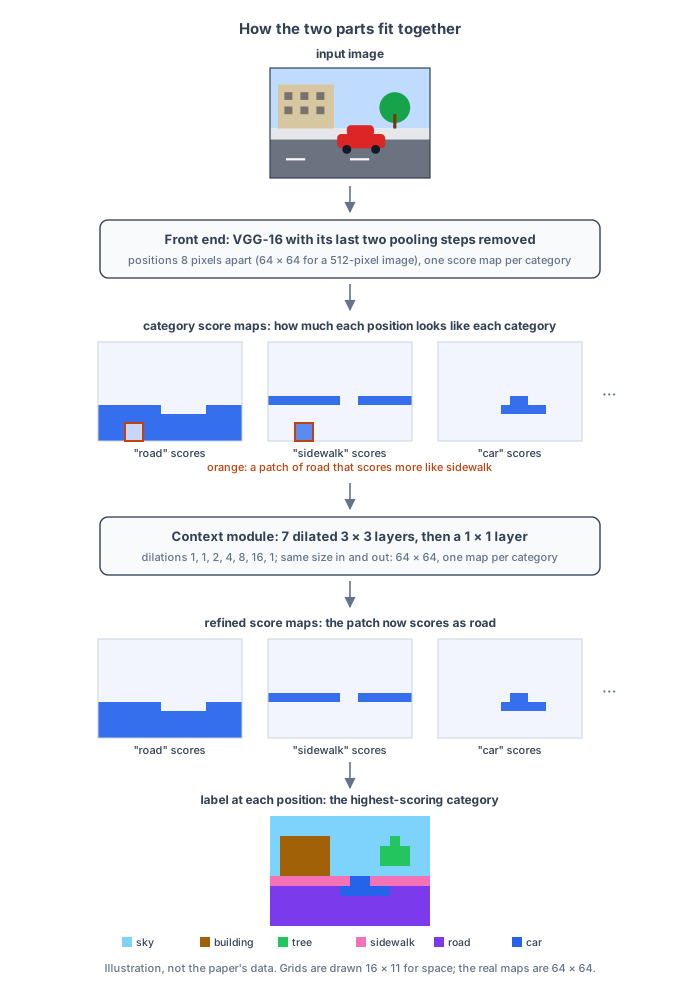
The network doesn’t score each pixel directly. It produces a smaller grid, and each square in that grid is called a position. Neighboring positions are 8 pixels apart in the original image (the next section explains why 8). Position 1 corresponds to pixels 1–8, position 2 corresponds to pixels 9–16, and so on. So an image about 512 pixels on a side becomes a 64 × 64 grid of positions.
The paper’s network has two parts:
- a front end, adapted from a classification network, that turns the image into a map of category scores, one score per category at each position;
- a context module, a small stack of dilated layers placed after the front end, that improves those scores by looking at wider areas.
The categories come from the dataset’s fixed list, chosen before training: 21 for Pascal VOC (20 kinds of object, plus background).
The front end: remove the last two shrinking steps
The front end starts from VGG-16, the 16-layer classification network from Oxford. VGG-16 halves its maps five times with pooling. The authors removed the last two of those pooling steps entirely.
Removing them would normally change what the later layers see: without the shrinking, each 3 × 3 filter after that point would cover a smaller part of the image than it did during VGG’s original training. To make up for it, the authors increased the dilation of those later convolutions by a factor of 2 for each pooling step they removed: the layers after the first removed step use dilation 2, and the layers after both use dilation 4.
Each filter then reads from the same area of the image as before, which means the layers can start from VGG-16’s already-trained weights. Three halving steps remain, so neighboring positions are 2 × 2 × 2 = 8 pixels apart. For an image about 512 pixels on a side, the output is 64 × 64 instead of the much smaller map a fully shrinking network would produce.
They also removed the padding between layers, which VGG-16 used for classification but which the paper says isn’t needed when labeling every pixel.
Result. The simplified front end was more accurate than the earlier segmentation networks built from VGG-16, on the PASCAL VOC 2012 test set:
- FCN-8s (Long et al.): 62.2% mean IoU
- DeepLab (Chen et al.): 62.1%
- the paper’s front end: 67.6%
The context module
The context module is a separate stack that takes the front end’s category maps and refines them. Its job is to bring in wider context: for example, a patch whose label is unsure between road and sidewalk can be settled by what is around it. The basic version has 8 layers:
- layers 1 to 7: 3 × 3 convolutions with dilations 1, 1, 2, 4, 8, 16, and 1;
- layer 8: a 1 × 1 convolution that produces the final scores.
After layer 6, each output depends on a 65 × 65 area, already wider than the front end’s 64 × 64 map, so the module stops widening there. Every layer keeps the map at 64 × 64.
Its input and output have the same form, one map per category, so it can be added to other networks that label every pixel.
It is also small. Each output map reads from every input map with its own filter, so each pair of maps gets 9 weights in each of the seven 3 × 3 layers, plus 1 in the last: 64 for each pair. For Pascal VOC’s 21 categories, that comes to 64 × 21 × 21 = 28,224 weights, compared with about 138 million in VGG-16.
Starting the module as a pass-through
The authors’ first attempts to train the context module “failed to yield an improvement.” The usual way to start a network, with small random weights, did not work for it.
What worked was starting every layer so that it passes its input through unchanged: each filter starts with a single 1 in the center, on its own map, and 0 everywhere else. In the paper’s words, this “sets all filters such that each layer simply passes the input directly to the next.” Training then moves the weights away from that starting point only where wider context helps.
This is close to the idea behind Paper #4’s shortcut that leaves the signal alone: start from “do nothing” and let training learn the change. Here it is done with the starting weights rather than with a shortcut. The authors raise a natural concern, that training might never move away from passing the input through, and report that “experiments indicate that this is not the case.”
How much the context module helped
On the PASCAL VOC 2012 validation images, with a front end trained on more data (VOC plus images from Microsoft’s COCO dataset):
- front end alone: 69.8% mean IoU
- with the basic context module: 71.3%
- with a larger context module, which uses more maps in its middle layers, up to 32 times as many as the basic version: 72.1%
The large module also helped systems that already used a separate clean-up step after the network: it raised one that used a CRF from 71.6% to 73.3%, and one that used CRF-RNN, a trainable version of the same step, from 72.5% to 73.9%.
What’s next
The final post covers the test-set and street-scene results, where the idea came from, and what the paper’s approach still leaves open.