Paper #6: Looking Inside, and What It Left Open
A few of a trained RNN's memory values track things nobody told it about, such as whether it's inside a quote. Karpathy also names what RNNs do poorly, and points to attention as the next step.
Where we are: the last post showed what RNNs wrote after training on 6 different texts. This post looks inside the trained networks, and covers what Karpathy says RNNs don’t do well.
Watching single memory values
The network’s memory is a list of 512 numbers, and the network updates every one of them after each character it reads. Karpathy took one of those numbers, the same one throughout, and watched how it changed as the network read a passage of text. He colored each character by that number’s value right after the network read it: one color when the number was high, another when it was low. Then he did the same for other numbers in the list, one at a time (the figure below shows the one that tracks quotes).
For most of the numbers, the colors showed no pattern a person could name. For about 5%, they did. The examples below come from his networks trained on Wikipedia, War and Peace, and the Linux code:
- Inside a quote. One value turns on at an opening quote mark and stays on until the quote ends.
- Inside a link. One turns on inside Wikipedia’s
[[double bracket]]links and off outside them. It can’t turn on at the 1st ”[”, only at the 2nd, so, Karpathy suggests, another part of the memory is likely counting the brackets. - Position in a link. One rises steadily from the start of a
[[ ]]link to its end, which tells the network how far into the link it is. - Inside a web address. One is on inside URLs and off outside them.
- Position in a line. One changes gradually along each line of text.
- In code: values that are on inside
ifstatements, inside comments, or deeper inside nested brackets.
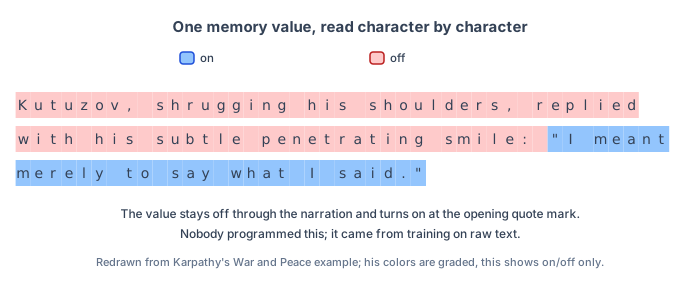
Nobody told the network that quotes or brackets exist, or that tracking them would help. It was only trained to predict the next character. Keeping track of “am I inside a quote?” helps with that prediction, since a closing quote mark is likely only when one is open. So one memory value gradually came to do it during training.
Karpathy is careful about how much to read into this. He calls some of his own explanations “hand-wavy,” meaning informal and not proven, since the memory is 512 numbers working together, and most single values don’t mean anything on their own.
This is the same kind of inspection Paper #1 did for image networks, where visualizing what a layer responds to showed edge and texture detectors that nobody had designed either.
What RNNs do poorly
Karpathy’s post ends with the problems he saw in RNNs in 2015.
- Long-range memory. The proof and lemma mix-up and the late arrival of topics in the War and Peace samples both come from information that has to be held across a long stretch. LSTMs help, but don’t remove the problem.
- Memorizing more than generalizing. RNNs, he writes, “memorize sequences extremely well,” but don’t always show convincing signs of generalizing the right way.
- Memory size is tied to cost. At every step, a table of weights connects each of the 512 old memory values to each of the 512 new ones: 512 × 512 weights. Doubling the memory to 1,024 values makes that 1,024 × 1,024, which is 4 times as many weights and 4 times the work for that part of every step. Karpathy’s wish is a memory that could hold a lot at once, such as all of Wikipedia, without the work at each step growing. With a memory that works this way, every added value adds work at every step, so that isn’t possible.
In 2015, models that predicted one whole word at a time seemed to work better than models that predicted one character at a time, like the ones in this post. Karpathy predicted that this gap was “surely a temporary thing.” Today’s language models split text into word pieces, called tokens: common words usually get one token each, and rare words are split into several. Word pieces fall between the two models he compared: bigger than single characters, smaller than whole words.
Incidentally, these are the same tokens that companies charge for when they sell access to a language model. They count 2 kinds separately:
- Input tokens: everything the model reads. That includes the new message, plus the earlier conversation and any attached documents, since the model rereads all of that on every turn.
- Output tokens: everything the model writes. These usually cost several times more each, because the model produces them one at a time.
In English, a token averages about 4 characters, or about ¾ of a word. Each company splits text a little differently, so the same text can come to a different number of tokens with different models.
Attention
As one direction for fixing the long-range memory problem, Karpathy points to attention. A plain RNN has to carry everything it has read through its step-by-step memory, and older information fades. With attention, the network keeps the memory values from every earlier step and, at each new step, looks back at all of them directly. It gives each one a weight for how relevant it is right now, and reads a blend weighted that way.
Karpathy calls this soft attention: “soft” because it reads a blend of every part instead of picking just one. It has a cost of its own: reading a blend of every stored step means doing work for every one of them, at every step, so the work at each step grows as the text gets longer.
The translation paper he cites (Bahdanau et al.) shows what this looks like. When the network is about to write the French word for “cat,” it gives most of its weight to the memory values from the English word “cat,” even if that word came 10 words earlier. Nothing has to survive a long chain of steps to be used.
In 2015, Karpathy called attention “the most interesting recent architectural innovation in neural networks.” It turned out to be more than that: attention is the central part of the transformer, the design today’s language models are built on. Attention is also where this reading list goes in Chapter 3, which starts with that 2014 translation paper, Paper #10, and leads to the transformer, which drops the step-by-step memory entirely and uses attention in its place.
What’s next
Every experiment in Karpathy’s post used LSTMs, and Karpathy skipped how they work. Paper #7, Christopher Olah’s “Understanding LSTM Networks” (2015), covers the LSTM’s update step and why it holds on to information over longer stretches than a plain RNN.