Paper #6: From Fixed Inputs to Sequences
Every network in Chapter 1 takes in a whole image at once and answers in one pass. Paper #6 is about recurrent networks, which read a sequence one piece at a time and carry a memory of what they've read.
Where we are: Paper #5, Dilated Convolutions, finished Chapter 1, on networks that see. Chapter 2 is about networks that handle sequences: text, audio, and anything else that arrives one piece after another.
What the papers so far have done. Every network in Chapter 1 takes in a whole image at once and answers in one pass, through the same fixed number of layers: one score per category, or one label per pixel. The classifiers also need the image at a fixed size, such as 224 × 224. Paper #5’s network accepts images of different sizes, but it still reads the whole image in one pass.
What Paper #6 is for. “The Unreasonable Effectiveness of Recurrent Neural Networks” (Andrej Karpathy, 2015) is a blog post, not a formal paper, but it’s on the 30 papers list, so this series counts it as Paper #6. Karpathy was then a PhD student at Stanford and one of the instructors of CS231n, the course behind Paper #1. The post explains recurrent neural networks (RNNs): networks that read a sequence one piece at a time, such as one character of text at a time, and carry a memory of what they’ve read so far. Karpathy trains one to predict the next character of a text, then shows what it writes after training on Shakespeare, Wikipedia, a math textbook, and the Linux source code.
Why it matters. Predicting the next piece of text, then adding that guess to the text so far and predicting the one after it, is how today’s large language models write. They predict word pieces, called tokens, instead of single characters, and they use transformers (Chapter 3) instead of RNNs, but the task is the same. This post shows that task working in 2015, with networks of a few million weights, trained on a single graphics card.
What a fixed-size network can’t do
A sentence can be 3 words long or 30. A recording can last 2 seconds or 2 minutes. A network built for one fixed input size, the way the classifiers expect exactly 224 × 224 pixels, has no natural way to take in either one: the input has to be cut or padded to that size first.
The output has the same limit. A classifier’s output is a fixed list of scores, one per category. It can’t answer with a sentence, because a sentence can be any number of words long.
An RNN gets around both limits by working in steps. At each step it can read one piece of the input, updates its memory, and can produce one piece of output. The step is the same every time, so it can repeat as many times as the sequence needs.
Five shapes of input and output
Karpathy draws five ways a network can map inputs to outputs. Each red box is an input, each blue box is an output, and each green box is the network’s hidden layer, which in an RNN is its memory. A green arrow pointing right means the memory is passed on to the next step.
| Shape | Diagram | Examples |
|---|---|---|
| One input, one output | 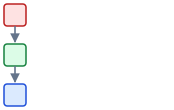 |
|
| One input, a sequence out | 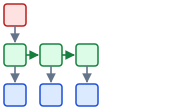 |
|
| A sequence in, one output | 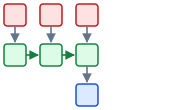 |
|
| A sequence in, then a sequence out | 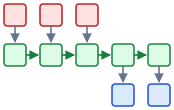 |
|
| A sequence in, an output at every step | 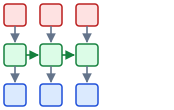 |
|
In shapes 2 to 5, nothing fixes the length of the sequences. The diagrams draw 3 or 5 steps, but any number works. The same step runs once per piece, for however many pieces there are.
Steps for data that isn’t a sequence
Karpathy also points out that an RNN can work in steps even on data that isn’t a sequence, by going through it in a chosen order. He shows two examples from DeepMind. In one, a network reads the digits of a house number from a photo, moving its focus from left to right. In the other, a network draws an image of a digit by adding to the canvas a little at a time.
So the step-by-step approach isn’t limited to text and audio. Tasks that aren’t about sequences can still be done in steps, as long as each step can use what the earlier steps did.
The rest of Paper #6
- How an RNN remembers: the memory, the update at each step, and why the same weights are reused every time.
- Predicting the next character: Karpathy’s “hello” example, how the network is trained, and how it writes new text.
- What it learned to write: samples from each dataset, from spelling to code, and what the network loses track of over long stretches.
- Looking inside: single memory values that track things like “inside a quote,” and the limits Karpathy names.
What’s next
The next post covers what an RNN’s memory is and how it changes at each step.